Mass Spectrometry Laboratory
For many years, the Department of Radioisotopes has been involved in environmental research. Its main aim is the reconstruction of timescales for the environment evolution in the last 300 thousand years. The reconstruction is performed on the basis of radiocarbon and luminescence dating, as well as lead dating of young sediments; the dating is supplemented by investigating characteristic features of the environment based on investigation of carbon and oxygen stable isotopes. In the last six years, isotopic measurements have been performed in tree rings (since 2 years - within the project ISONET).
Parameters of the instrument
The IsoPrime mass spectrometer is used for the determination of light stable isotope ratios (hydrogen, carbon, oxygen and sulphur); the instrument is of the continuous flow type. The elemental analyser EuroVector is used for the preparation of organic samples in the measurement system.
The mass spectrometer in conjunction with an elemental analyser is a modern instrument which enables the measurement of the isotope ration of light stable isotopes in gases and in organic and inorganic samples. The samples introduced to the ion source of the spectrometer have to have the form of gaseous N2, O2, CO2, SO2, CO or N2O. In addition, an electromagnet for analysing the ratio H/D is installed. The gas is injected into the spectrometer by a special injection device working in continuous flow mode.
The main parts of the spectrometer are:- investigated sample and standard gas injection system,
- ion source,
- ion beam analysis system equipped with an electromagnet separating gas ions for the analysis of the D/H ratio, carbon, nitrogen, oxygen and sulphur,
- collectors of measurements of carbon, nitrogen, oxygen and sulphur,
- vacuum line with vacuum pumps,
- computer system for measurement management with analysis software,
- the spectrometer can be upgraded for working in the dual inlet mode as well.
- combustion ovens with temperature stabilisation systems,
- reactors for combustion, reduction and pyrolysis of organic samples (depending on the needs the analyser can be configured for measuring: C, O, N, H or S),
- gas chromatograph system for separating gasses created during the reaction and injecting them into the spectrometer,
- automated system for sample preparation in gas form,
- automated sample feeder for 78 samples.
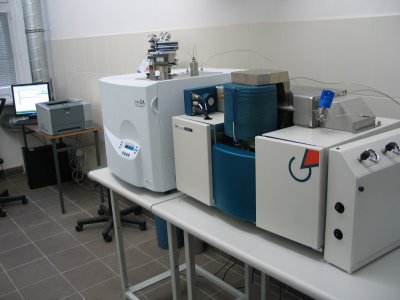
Mass spectrometer system from the left: computer system for controlling the operation of the spectrometer, as well as registering and analysing measurement results, elemental analyser serving as the sample preparation system, mass spectrometer, system for injecting samples and standard gasses into the ion source of the spectrometer
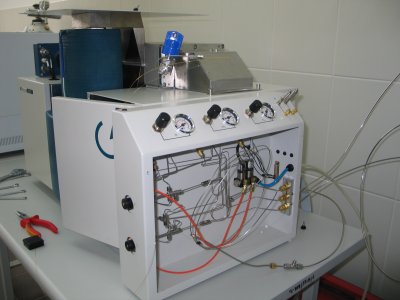
The system for injecting standard gasses and investigated into the ion source of the spectrometer.
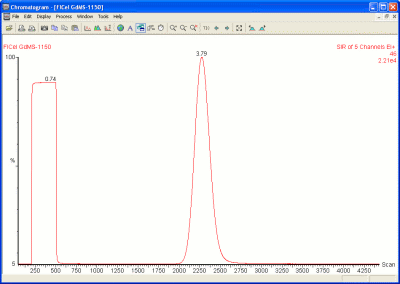
An example of a spectrum registered during the measurements of isotopic carbon composition. The first, square peak originates form the reference gas and the second, Gaussian peak from the measured sample.
First comparison measurements
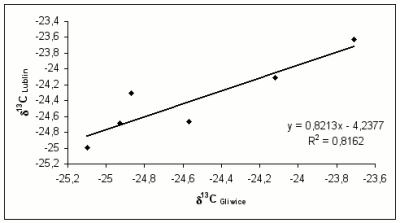
In the first half of July 2006, after finishing the work connected with the installation of air conditioning of the room, the installation of the spectrometer IsoPrime and the elemental analyser EuroVector commenced. The installation was performed by the Service Engineer Christian Matus from the company GV Instruments GmbH who is the manufacturer of the installed spectrometer. The installation took about two weeks. Employees of the Department of Radioisotopes who were designated for running the spectrometer in the future in the Mass Spectrometry Laboratory also participated in the installation. They were also trained in the use of the spectrometer. The training included direct sample preparation for spectrometric measurements, running of the spectrometer and elemental analyser, as well as the use of the software delivered together with the purchased spectrometer and analyser. During the stay of the engineer from GV Instruments first attempts to measure δ13C and δ18O were undertaken. After finishing the installation, the employees of the Department started the calibration of the spectrometer. The calibration consisted of measurements of stable isotope ratios in materials of known isotopic ratios. For the calibration, materials were used that were sent to partners in the project ISONET for interlaboratory calibration; in addition, α-cellulose obtained from wood samples collected within this project was also used for calibration. The stable isotope ratios of the α-cellulose extracted in the Gliwice Laboratory were in part investigated in the FZ Laboratory in Halle-Saale (Germany, participant of the ISONET project), and in part in the Mass Spectrometry Laboratory of the Maria Curie-Skłodowska University in Lublin, Poland. The attached plots present a comparison of the results obtained in Gliwice with the results obtained in the other laboratories. Graph 1 shows the comparison of δ13C (expressed in per mil of PDB) obtained in the Gliwice Laboratory with results obtained in Halle; graph 2 - a similar comparison with results from Lublin. Apart from the calibration of the spectrometer for stable carbon isotopes, also attempts to calibrate the stable oxygen isotope ratios have been undertaken. In this case, the results are not yet sufficiently satisfactory and they require further development and improvement of their accuracy.
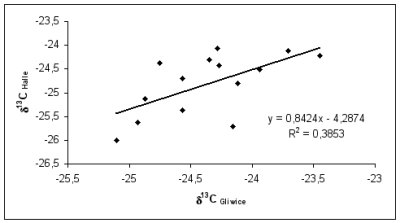
First results of comparison of the carbon isotopic ratios in organic matter carried out in the mass spectrometry laboratories in Halle, Lublin and Gliwice.